
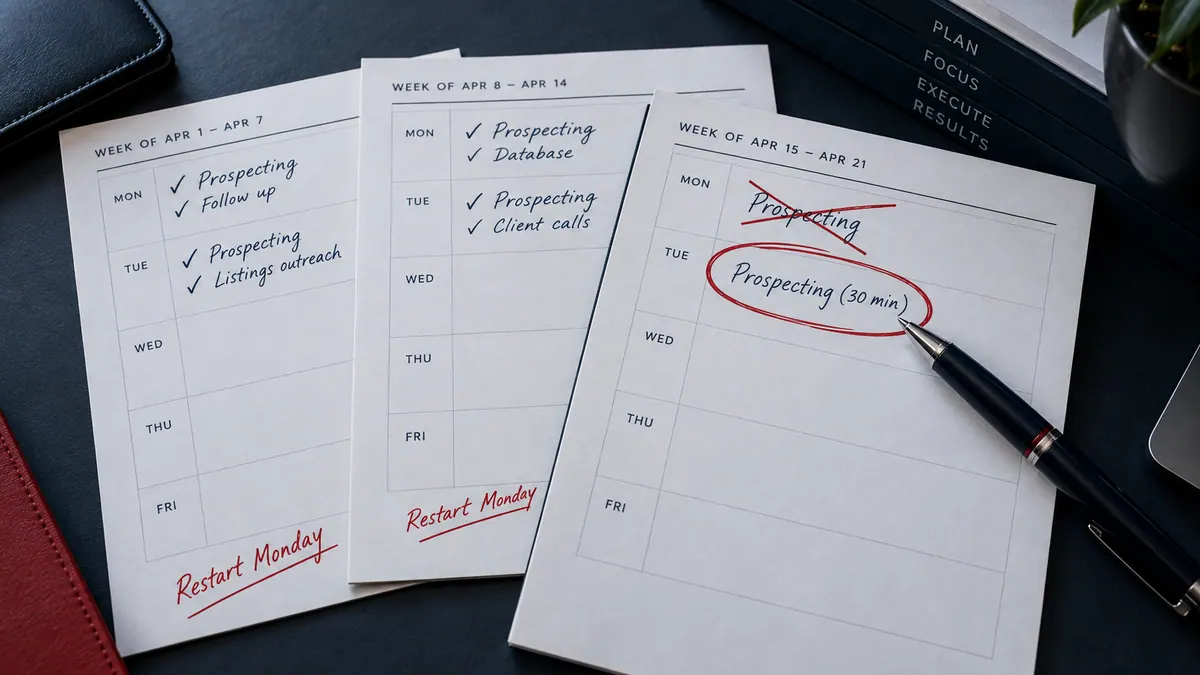
You know the cycle. You get frustrated, decide things are going to change, and Monday morning you are back at it. Calendar blocked. Prospecting done. Follow-up handled. You feel like yourself again.
Then real estate happens. A transaction gets messy. A client needs you. You miss a morning, then another. The calendar starts slipping, prospecting becomes optional, and follow-up begins piling up. A week later you are back where you started, making another plan to start again.
The obvious cost is inconsistent production. I do not think that is the biggest cost. The bigger cost is what repeated restarting does to your time, your momentum, and eventually your trust in your own commitments.
Starting feels productive
There is a reason a fresh start feels so good. The new calendar is clean. The new plan makes you feel organized. The new routine creates the feeling that this time will be different.
You get the emotional reward immediately, before the system has actually produced anything. That is where planning can quietly become a substitute for execution.
You probably do not need another fresh start. You need something that survives Wednesday.
Consistency does not mean never missing
Real estate is going to disrupt your schedule. You will have bad days. Transactions will blow up. Family stuff will happen. Energy will drop. Something unexpected will take over a morning.
The question is not whether your plan gets interrupted. It will. The better question is what happens next.
If one missed prospecting block turns into four missed days, the original interruption is not really the problem. The problem is that there was no clean way back. Reliable people are not people whose plans never break. They are people who return quickly without rebuilding everything from scratch.
Every stop creates reentry work
This is the part I think agents underestimate. When you stop for a while, you have to remember where you left off, reorganize the list, rebuild the calendar, catch up on follow-up, decide what matters again, and convince yourself to begin.
That work creates very little revenue. It is the work required to get yourself back to the point where you can do the work that creates revenue. Do it once and who cares. Do it every few weeks for years and the cost gets big.
The start-stop cycle taxes your time, attention, confidence, energy, and production.
It also changes the evidence you have about yourself
Suppose every Sunday you tell yourself you are going to prospect Monday through Friday. Then you repeatedly do it Monday and Tuesday and abandon it by Thursday.
Eventually you stop fully believing the plan. You can still make it. You can still get excited about it. But somewhere in the back of your mind is the evidence from the last ten times you did the same thing.
That matters because self-trust is not built by telling yourself you are disciplined. It is built by seeing yourself keep commitments. That is why smaller completed commitments can be more valuable than a giant perfect plan you cannot sustain.
Build a floor, not a perfect week
Perfect weeks look great on paper. Two hours of prospecting every morning, inbox zero, all follow-up complete, marketing handled, family time protected, workout done, weekly planning finished. Then Tuesday gets complicated and the whole thing collapses.
I would rather know what you can reliably execute during a difficult week. That becomes your floor.
Maybe your minimum prospecting standard is thirty minutes. Maybe your follow-up standard is clearing everything due that day. Maybe your shutdown standard is five minutes of planning for tomorrow.
Those are not your maximums. They are the important behaviors you do not allow to completely disappear. That continuity is what keeps one bad day from becoming another full restart.
Create a reset before you need one
Most plans tell you what to do when everything goes correctly. That is the easy part. What happens when you miss? If you miss the morning prospecting block, what is the rule? If you lose an entire day, what happens tomorrow? If you have a terrible week, what happens Monday?
Decide that now, while you are thinking clearly.
A reset can be as simple as this: if I miss one day, I resume the normal schedule the next day. I do not double the workload. I do not punish myself. I do not redesign the plan. I return.
Simple is good. The goal is not punishment. The goal is getting execution back online quickly.
Track recovery time
Here is a number worth paying attention to: how long does it take you to return to your important behaviors after disruption? One day? Three days? Two weeks? That number may matter more than how often you get disrupted because disruption is unavoidable. Long recovery periods are not.
If you want to improve consistency, work on reducing recovery time.
For the next week, pick one behavior that matters. Define the minimum version, when it happens, what counts as complete, and what you do if you miss. Then run it for seven days.
At the end, do not ask whether you felt motivated. Look at the evidence. Did the behavior happen? When the day got disrupted, how quickly did you return? Where did the system break?
That is how reliability gets built. Not with another dramatic restart, but with smaller promises kept over and over again.
If you recognize yourself in this cycle, take the complimentary Realtor Execution Audit. It will help you identify where your consistency breaks, what keeps knocking you off track, and where you need a better reset instead of another fresh start.